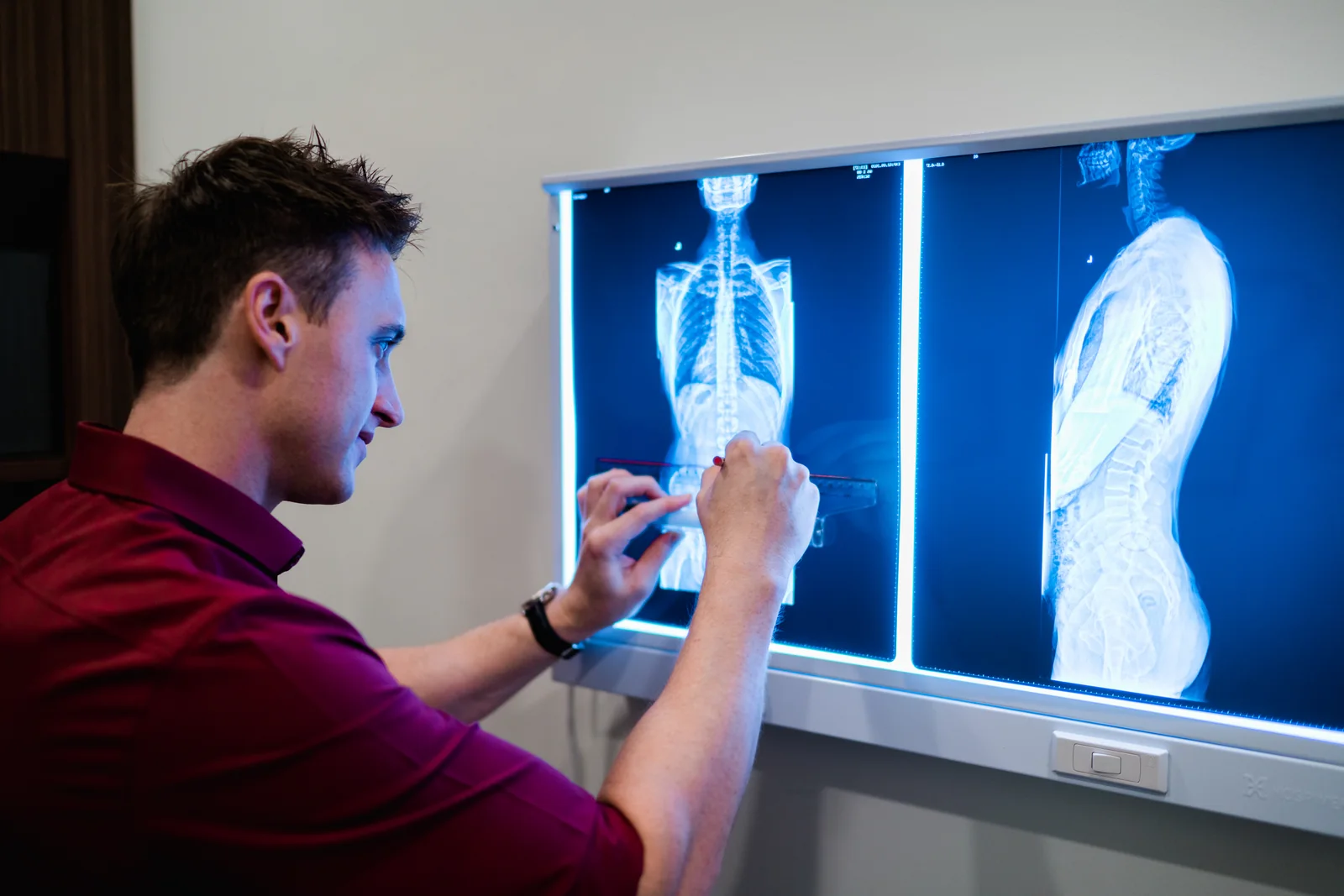
Scoliosis — postural and structural management for adolescents and adults.
Scoliosis is a long-term clinical relationship, not a single treatment. We work alongside orthopaedic care, focused on slowing progression and managing the secondary musculoskeletal pain.
First visit$88 · 60 min · assessment and treatment
Typical durationScoliosis management is long-term.
Treatment typeNon-surgical, drug-free
Self-check
Recognise these symptoms?
Visible asymmetry of the shoulders, waist, or hips
Postural fatigue
Back pain — particularly with prolonged sitting or standing
Reduced spinal mobility
If three or more sound familiar, a 60-minute first visit — assessment and treatment with a doctor — will tell you what is producing them, and whether our care is the right path for your condition.
Scoliosis is a sideways curvature of the spine that develops most commonly in adolescence but can also present in adults from degenerative changes. Conservative care focuses on slowing curve progression, improving postural function, and reducing the secondary musculoskeletal pain that often accompanies the curvature.
Our treatment approach
Care depends on the type, severity, and age of the patient. We work alongside orthopaedic management where appropriate. Conservative treatment combines manual therapy to address joint restriction and muscular compensation, postural and breathing rehabilitation, and a structured exercise programme calibrated to the specific curve pattern.
Modalities used
Manual therapy
Postural rehabilitation
Rehabilitative exercise
Low-level laser therapy
What to expect
Scoliosis management is long-term. Most adolescent patients benefit from a sustained programme through to skeletal maturity; adult patients typically follow an active phase of 3–6 months followed by maintenance.
If this matches your symptoms
Most cases of scoliosis are non-surgical when treated with the right protocol.
Every patient begins with a 60-minute first visit — a full assessment and first treatment with a doctor, for $88 online.
If our care is not the right path for your condition, we will say so and refer you on.
Our patient-care team is happy to walk through anything else over the phone or WhatsApp.
Chiropractic care cannot cure scoliosis, but it is an effective way to manage symptoms. A scoliosis chiropractor uses spinal adjustments, soft tissue therapy, and corrective exerc ise s to reduce pain, improve mobility, and support better posture.
A spinal curvature of 10 degrees or more is classified as scoliosis. Mild curves are managed conservatively through chiropractic care and corrective exerc ise, while curves above 40 degrees may require more intensive intervention, including possible surgery. Early assessment is always recommended.
Chiropractic scoliosis treatment is designed to be gentle and well-tolerated. Some patients experience mild muscle soreness after initial sessions, similar to the sensation after exerc ise, but this typically resolves quickly.
Duration depends on the type and severity of the curvature, your age, and how your body responds to care. Your clinician will outline a clear treatment schedule following your initial assessment.
Yes. The focus of treatment is management rather than cure. With consistent care, many patients live comfortably and actively with scoliosis.
Females are diagnosed approximately eight times more often than males during childhood and adolescence, largely due to hormone-driven growth spurts during puberty. Others at higher risk include those with a family history of the condition, individuals with neuromuscular disorders, and older adults experiencing degenerative spinal changes.
Treatment typically progresses through three phases:
an initial phase with more frequent v isi ts to address pain, inflammation, and mobility restrictions;
a stabilisation phase where frequency reduces as symptoms improve;
and a maintenance phase with periodic v isi ts to sustain spinal health.
Some patients notice meaningful improvements within several weeks, while others with more complex presentations benefit from an ongoing plan. Your clinician will outline a clear schedule following your initial assessment.
Maintain a consistent exercise routine with low-impact activities such as swimming and cycling to strengthen core muscles and support the spine.
Practice good posture by keeping the head aligned with the body when standing and avoiding prolonged static positions.
Incorporate stretching and flexibility exercises such as the cat-cow pose to relieve muscle tension and maintain spinal mobility.
Use stress-reduction techniques including deep breathing and meditation, as chronic stress can exacerbate pain and muscle tension.
Seek community support by connecting with others living with scoliosis for encouragement and shared experience.
Decades of combined clinical experience treating scoliosis across all age groups.
Personalized, non-invasive treatment plans built around each patient’s specific needs and goals.
Signature Functional Correction Method (FCM) integrating chiropractic care, soft tissue therapy, rehabilitation, and advanced technology.
Patient education at every step so you understand your condition and your options.
A one-stop chiropractic centre, reducing the cost and inconvenience of attending multiple clinics.
A holistic approach that addresses pain, alignment, posture, and long-term spinal health together.
For an evidence-based overview of scoliosis management, the National Institute of Arthritis and Musculoskeletal and Skin Diseases (NIAMS) provides authoritative guidance on diagnosis, monitoring, and treatment options.
Book your first visit
Speak to a clinician about what is causing your pain.
Your first visit is a 60-minute session with a doctor — a full assessment and your first treatment in the same appointment. We take your clinical history, screen your posture and movement, explain what we find in plain language, and begin treatment if your condition is suitable for our care.